

Living in St. Thomas | How Life Works on an Island Losing People While Cruise Ships Keep Growing
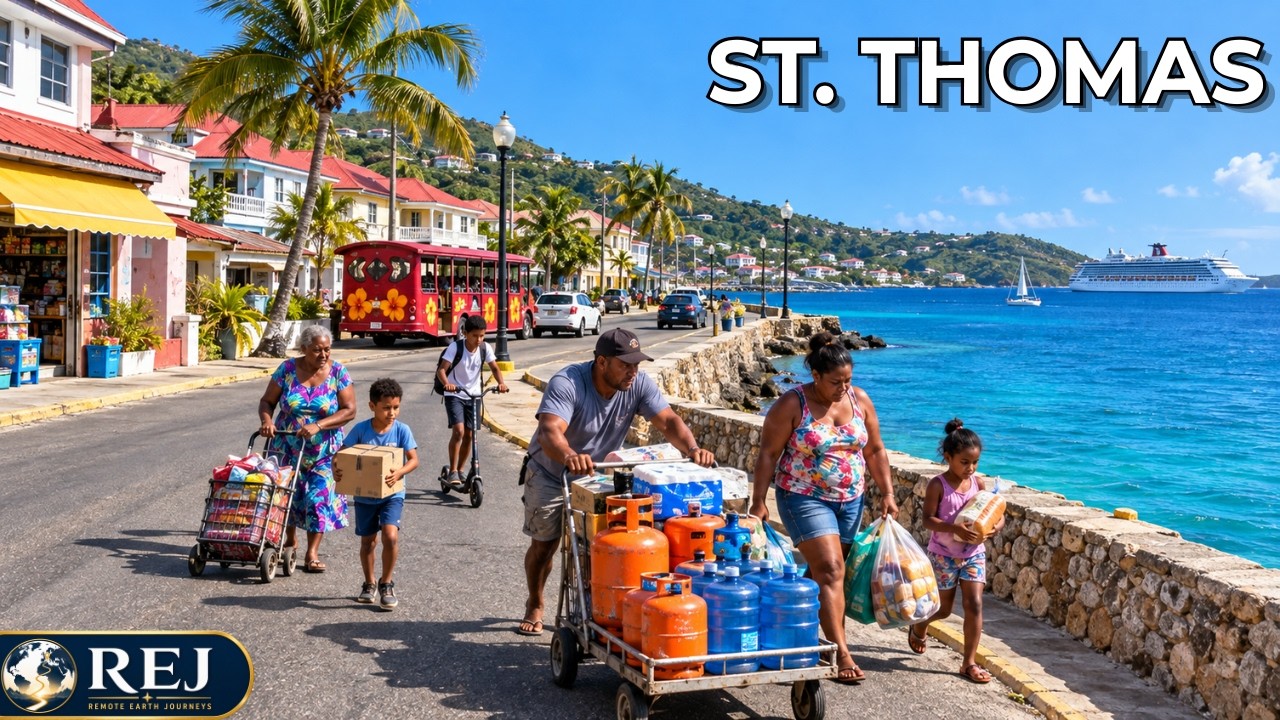
he biggest building in town arrives by sea. It ties up in the morning and leaves the same day. About 42,000 people live on St. Thomas, and across a year about one and a half million cruise passengers come through the St. Thomas–St. John district: roughly thirty-seven guests for every person who lives here. This documentary follows an ordinary day on the island, from the morning berth to the evening hill roads, and asks a plain question: how does a place this size carry a crowd that size? On an average January day more than nine thousand cruise visitors land, about one for every four or five residents. In August it is about two thousand a day. The ships come in the morning and go in the late afternoon, and on the busiest days of the winter season up to six are scheduled at once. We follow the chains that keep the island running. Water: rain off a roof, along a gutter, down a pipe and into a cistern that the building code requires under every new house, with an electric pump to lift it back up — and a seawater plant that can make up to 3.3 million gallons of drinking water a day. In 2022 the public system held about two and a half weeks of storage, and in dry months private trucks deliver water by the load, 3,250 or 5,250 gallons at a time. Power: in 2024 a kilowatt-hour here cost about thirty-three cents, twenty-two of them for fuel that arrives by sea — about twice what the average American home pays. Freight: most of what sits on a grocery shelf crosses the water in a container, and there are five handoffs before a box reaches the shelf. Then the road and the count. The safari, an open-air pickup with bench seats, works as the island bus, and the fare has been two dollars a ride since 2024. Traffic keeps to the left while most of the cars are American. And the census tells a second story: 51,634 people in 2010, 42,261 in 2020 — about nine thousand fewer, close to the number of cruise guests who land on one average January day. Two hurricanes, Irma and Maria, fell inside those ten years, two weeks apart in September 2017. One count is falling. The other is climbing. The film ends with the public list that never sails — a hospital, schools, the university campus above Brewers Bay, a road, a drain, a pump — and with the question the island asks itself: more ships bring more work, but how many can one island carry? Tell us where you stand in the comments. 🌍 Want to discover more places where everyday life works completely differently? Explore our other documentaries and journey with us to some of the world’s most remote communities. 👉 *Living on Pag-asa Island | How Life Works on an Island 4 Countries Claim* https://www.youtube.com/watch?v=mdNIWcc22ok 👉Living in Balabac | How Life Works Where One in Five Lives on a Sand Islet https://www.youtube.com/watch?v=q5pCTGNzaks 👉Living in Mackinac | How Life Works When Ice Stops Michigan's Ferries https://www.youtube.com/watch?v=j27LNtH9GvA 👉Living in Molokai | How Life Works Where Hawaii Sees the Fewest Visitors https://www.youtube.com/watch?v=LgYV9P2TlHk #stthomas #usvirginislands #cruiseport #documentaries #traveldocumentaries #traveldocuments #traveldocumentary #remoteearthjourneys Timestamps: 0:00 Intro 2:17 The Morning Berth 5:05 The Safari Road 7:35 Shop Windows and Freight 10:02 Rain, Tank, Pump 13:03 The Power Toll 15:45 Tank by the Inch 18:40 The Count 21:39 The Public List 24:32 Two Harbors 27:38 Sail-Away 30:44 Evening 33:37 Why They Stay